Mechatronics Engineer · Robotics · Data · Embedded Systems
Rodrigo Zamagno Medeiros
Building intelligent systems at the intersection of robotics, hardware, and data. Currently pursuing an Erasmus Mundus Master in Smart Systems across Finland, Norway & Hungary.
Studying miniaturized systems integrating data processing, multi-modal sensing, actuation, and communication — across Aalto (Finland), USN (Norway) and BME (Hungary). Currently working on a master's thesis on autonomous UAV-based orchard monitoring at USN.
2017 – 2022
Bachelor in Mechatronics Engineering
Universidade de Brasília (UnB) — Top student of the 2022 class · GPA 4.3/5
Comprehensive training in mechanics, electronics, control systems, and software engineering. Led the DROID autonomous robotics team as captain in 2019, competing nationally and internationally for five years.
2020
Exchange / Visiting Student
Visiting Student
Temple University — Philadelphia, United States · GPA 3.6/4
Courses: Machine Learning, Robotic Control using Raspberry Pi, Digital World 2020.
Professional experience
2025
Scientific Assistant — Seaguard Project
University of South-Eastern Norway (USN)
Analyzed coordination strategies and coverage algorithms for heterogeneous swarms of unmanned maritime vehicles. Supported R&D in marine and drone-related applications.
2022 – 2024
Data Engineer
AKAD Seguros — Insurance Company, Brazil
Designed and implemented the full AWS data platform integrating 6 data sources into a three-layer data lake. Built the Data Warehouse powering Power BI dashboards and actuarial analyses. Developed a generative AI email routing solution at an internal hackathon. Project featured in an official AWS Brazil blog post.
2021
Data Scientist Intern
Cyberlabs — Cybersecurity Startup, Brazil
Analyzed large structured and unstructured datasets from a cybersecurity app. Evaluated A/B test statistical confidence to assess churn rate reduction effectiveness.
2019
Team Captain — DROID Autonomous Robotics
Universidade de Brasília
Led a self-funded student robotics team of 20+ members. Coordinated internal competitions with mentoring structures, and competed in national and international autonomous robotics contests.
Projects
PythonYOLOv7AirSimUnreal EngineUAVComputer Vision
2025 · USN — Smart Systems Master
Drone-Assisted
Orchard Monitoring: Navigation, Tracking & Apple Detection
Autonomous UAV pipeline for orchard monitoring tested in a digital twin of a real orchard. YOLOv7 detection, waypoint navigation, and georeferenced per-tree apple counting.
→
CAD3D PrintingArduinoLaser CuttingSTEAM
2022 · Bachelor's Thesis
Reconfigurable Planetary System
A modular mechanical model of planetary motion where each planet can be studied independently. Built with 3D-printed and laser-cut components controlled by Arduino.
2025 · Master's Thesis · University of South-Eastern Norway
Drone-Assisted Orchard Monitoring
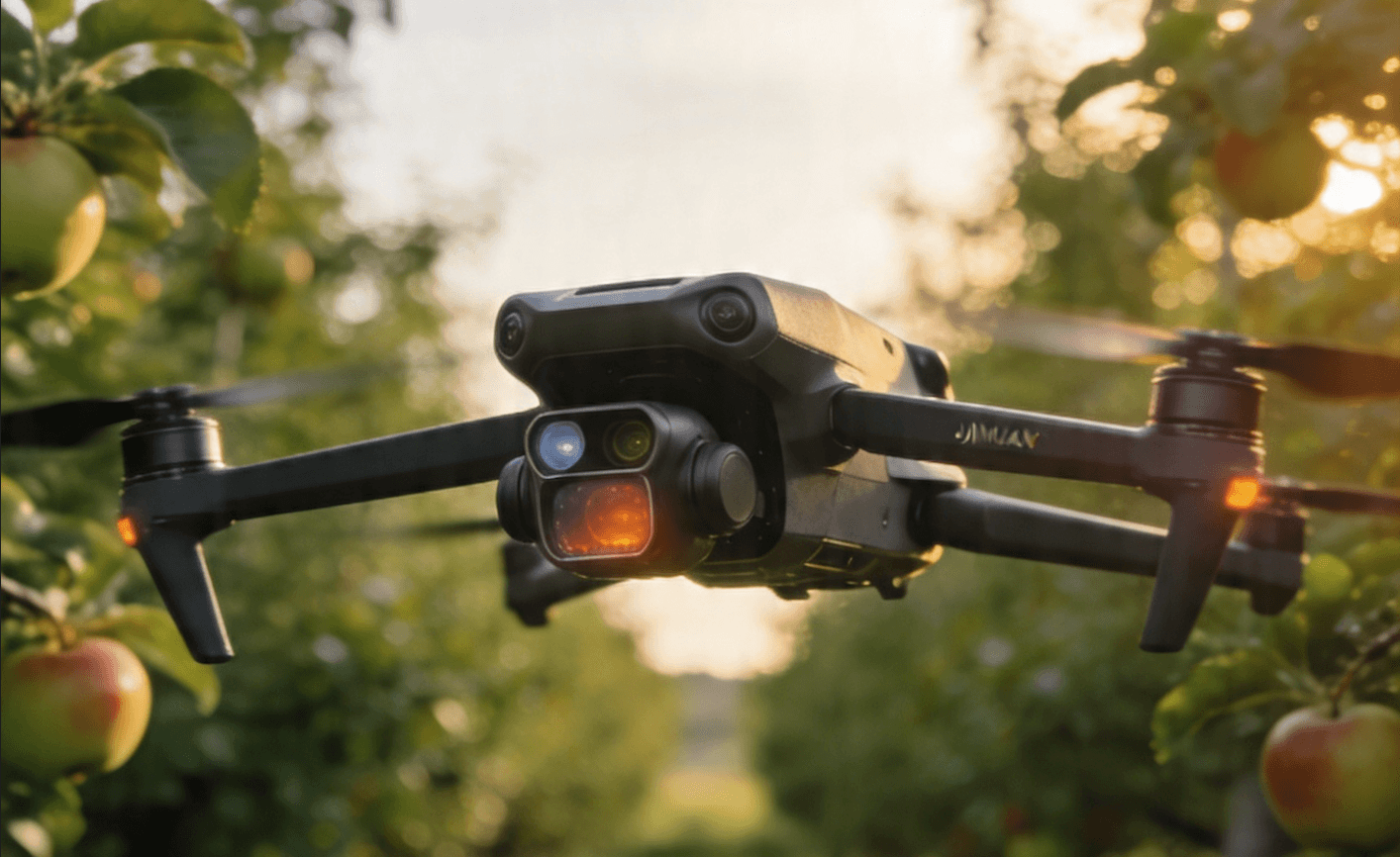
An autonomous UAV pipeline for orchard monitoring — built and validated in a digital twin of a real apple orchard using Unreal Engine and AirSim. Covers waypoint navigation, YOLOv7 apple detection, multi-object tracking, and georeferenced per-tree counting.
Manual apple counting is labour-intensive, inconsistent, and unscalable across commercial orchards. Growers need accurate fruit estimates to plan harvest logistics, but walking every row and counting by hand is impractical at scale.
This project builds an autonomous UAV pipeline that flies along orchard rows, detects individual apples using deep learning, and produces a georeferenced per-tree apple count — without any manual intervention during the flight.
Digital twin environment
The full pipeline was developed and tested in a simulated replica of a real apple orchard, built in Unreal Engine with AirSim as the flight simulator. Tree positions were GPS-matched from a real orchard dataset — creating a digital twin that reflects actual spatial layout and canopy density. The DJI Mavic 3T (thermal + RGB) was the target real-world platform.
Waypoint navigation
The UAV follows programmed waypoint paths running parallel to each tree row, with the camera oriented perpendicular — giving the detector a lateral view that exposes fruit that would be occluded in a top-down (nadir) pass. Flight altitude and inter-waypoint spacing were tuned to balance detection coverage against flight time.
Tree-facing flight paths: Rather than flying overhead, the UAV navigates at canopy height alongside each row. This lateral viewing angle dramatically improves fruit visibility compared to standard nadir surveys.
Apple detection — YOLOv7
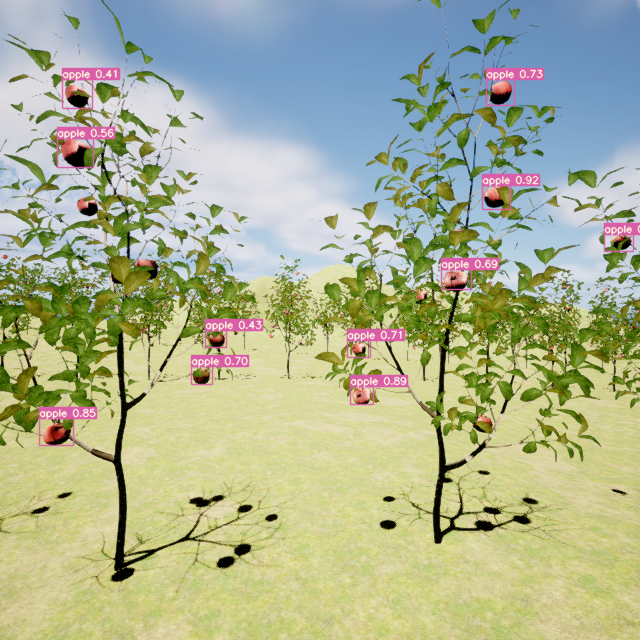
A YOLOv7 model was fine-tuned for apple detection on simulation frames, outputting bounding boxes and confidence scores per frame. Multi-object tracking was applied across frames to avoid double-counting the same fruit as the drone passes by. Each tracked detection was assigned a GPS coordinate from the drone's pose at detection time, producing a georeferenced apple map per tree.
YOLOv7 running on Unreal Engine simulation frames — bounding boxes with per-apple confidence scores
Results
The pipeline was validated against the simulated orchard where each tree has a known ground-truth apple count of 8. The per-tree apple count distribution tracked closely around the expected value, with the majority of trees detected within ±3 apples of ground truth across 160+ trees in the orchard.
160+
Trees monitored per full flight
~8
Expected apples per tree (ground truth)
GPS
Georeferenced count per individual tree
My contributions
Digital twin construction in Unreal Engine + AirSim with GPS-matched tree placement
Waypoint navigation system with tree-row-facing flight path planning
YOLOv7 fine-tuning and deployment for apple detection in simulation
Multi-object tracking pipeline to avoid double-counting across frames
Georeferenced per-tree apple count aggregation and result visualization
Supervisor: Fabio Augusto de Alcantara Andrade — USN
Ongoing master's thesis — results and methodology will be refined through the 2026 academic year.
2022 · Bachelor's Thesis · Universidade de Brasília
Reconfigurable Planetary System
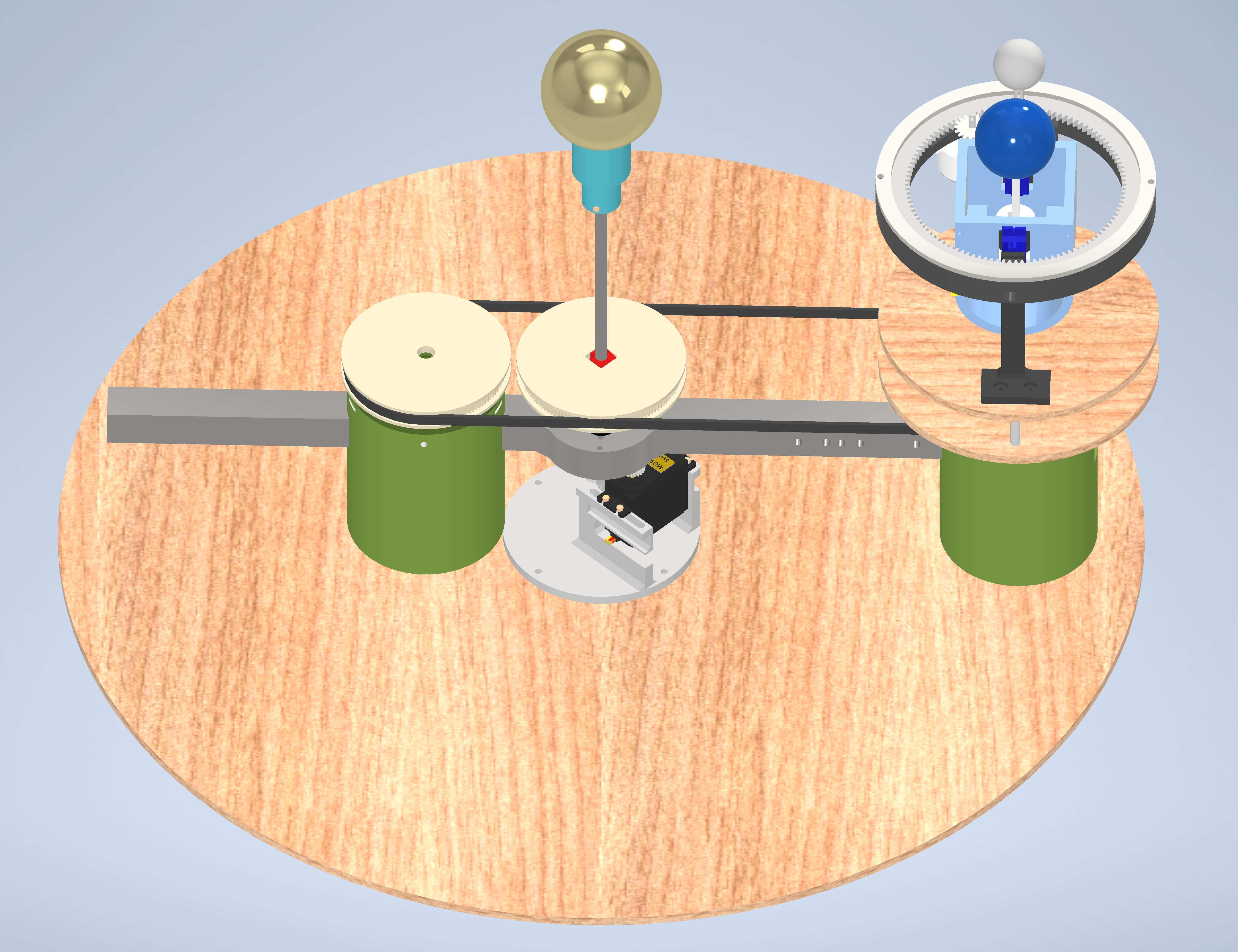
A modular mechanical orrery where each planet's translation, rotation, axial tilt, and satellite orbit can be studied independently — designed for STEAM education, with mathematically scaled dimensions and orbital periods.
Traditional solar system models are fixed — they show one configuration and can't be adapted to focus on a single planet or its satellite. For STEAM education this limits how teachers can use them interactively in class.
The goal was a modular system: the structure physically adapts depending on which planet is being studied, and each planet's orbital mechanics — translation, rotation, axial tilt, and satellite revolution — can be explored in isolation.
Scaled dimensions & orbital periods
Rather than arbitrary proportions, the system uses a base-10 logarithmic scale for planet diameters (so Jupiter at 51.6 mm and Mercury at 36.9 mm remain visually distinct) and a separate log scale for orbital distances — placing Mercury at ~100 mm and Neptune at ~200 mm from the central lamp. Orbital and rotation speeds are derived from real astronomical data, scaled so Jupiter's rotation period sets the maximum motor speed.
Mechanical design
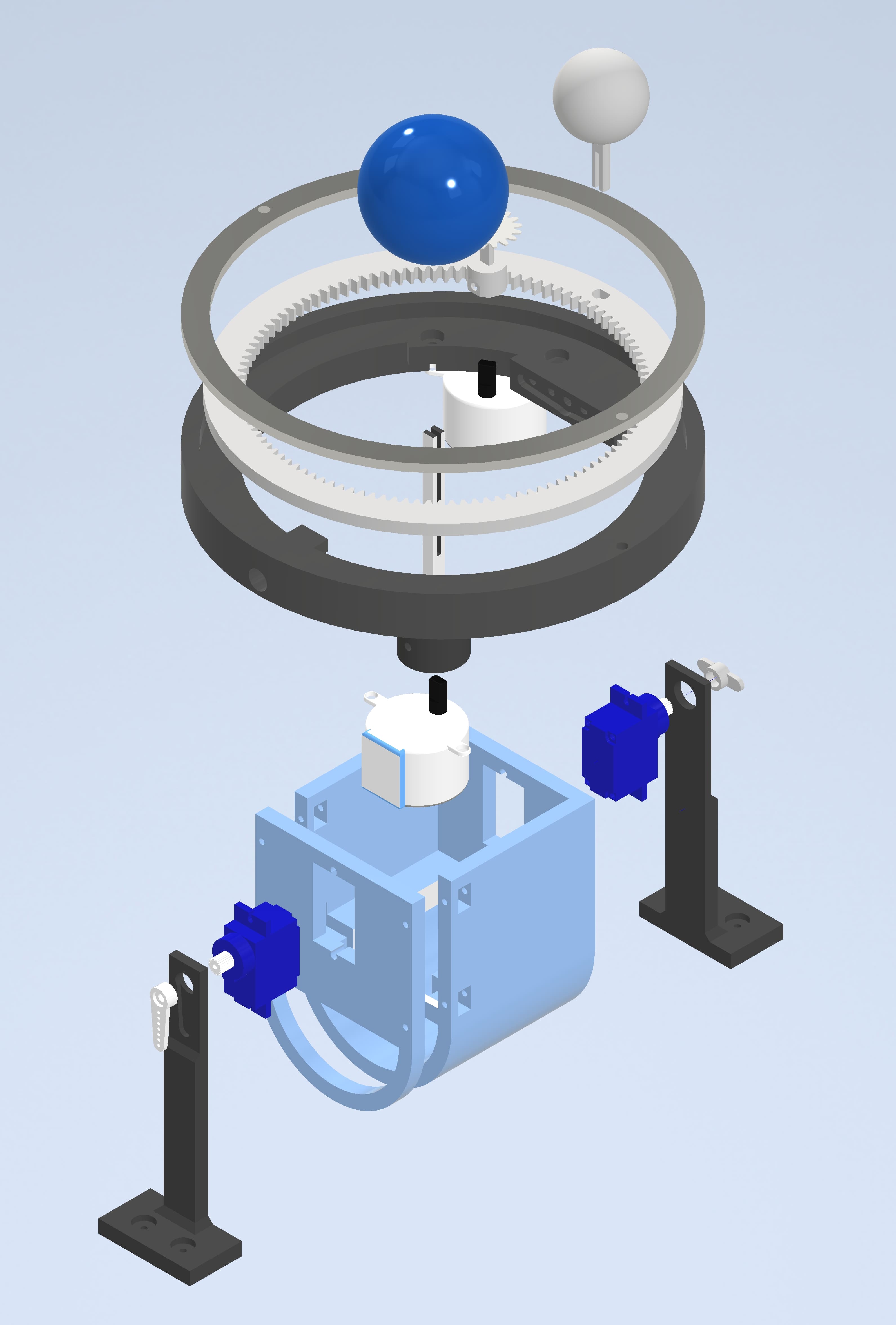
Each planet module uses a stepper motor for rotation, two micro-servo motors for axial tilt and satellite orbit inclination, and a ring gear driven by the satellite servo inside a compact planetary housing (Caixa Planetária). The satellite arm mounts on the ring and stays synchronized — always showing the same face toward the planet, reproducing synchronous rotation. All components were modelled in Autodesk Inventor, then fabricated via 3D printing (PLA) and laser-cut acrylic/MDF at the Laboratório Aberto de Brasília.
Exploded views
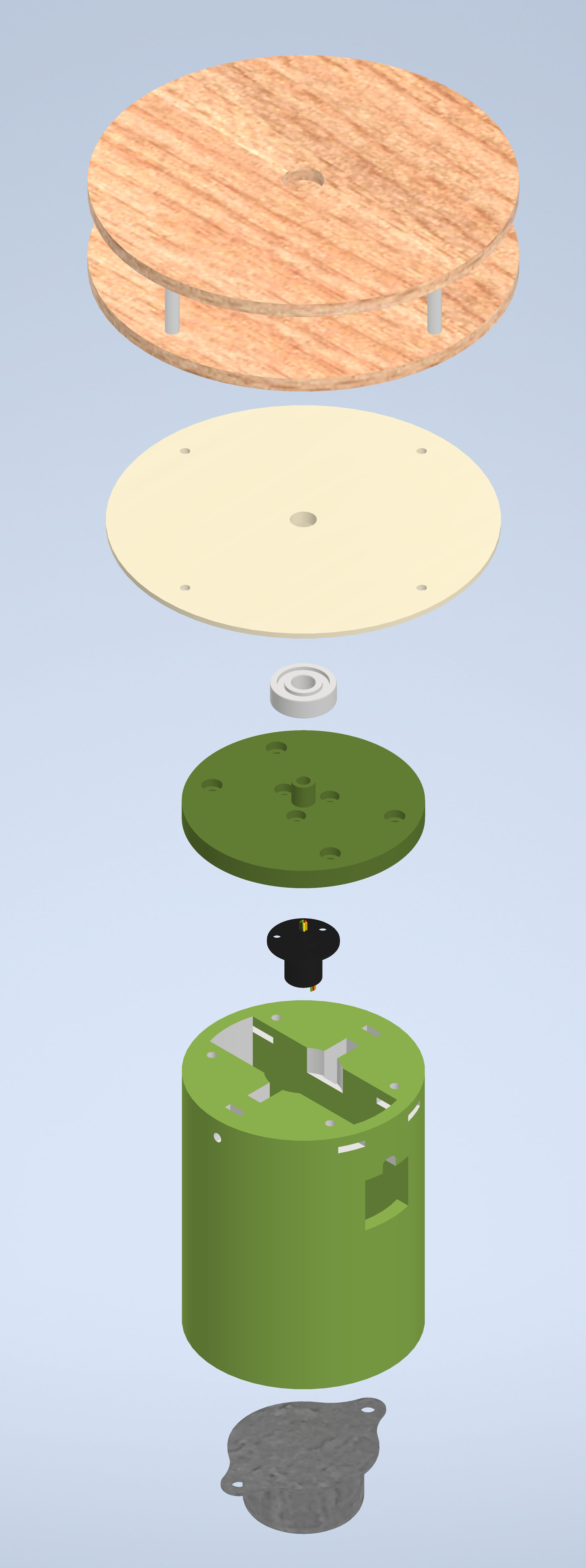

The three assemblies below show every modelled component: the main shaft and translation arm, the planetary support structure, and the full planet + satellite mechanism.
Planet & satellite ring assembly
Planetary support structure enclosure
Main shaft & translation arm (Eixo Principal)
Electronics & control
An Arduino Uno manages 4 motors simultaneously — a stepper for planetary rotation, a stepper for satellite revolution, and two servos for axial tilt and orbital inclination. Slip rings (anéis coletores) at rotation joints prevent wire tangling during full translation. Speed ratios are calculated from real astronomical data so each planet runs at its correct relative period.
Key challenge: The translation servo had only a 180° range, so the firmware automatically returns to the start position and continues, allowing continuous orbital demonstration within that constraint.
Final prototype
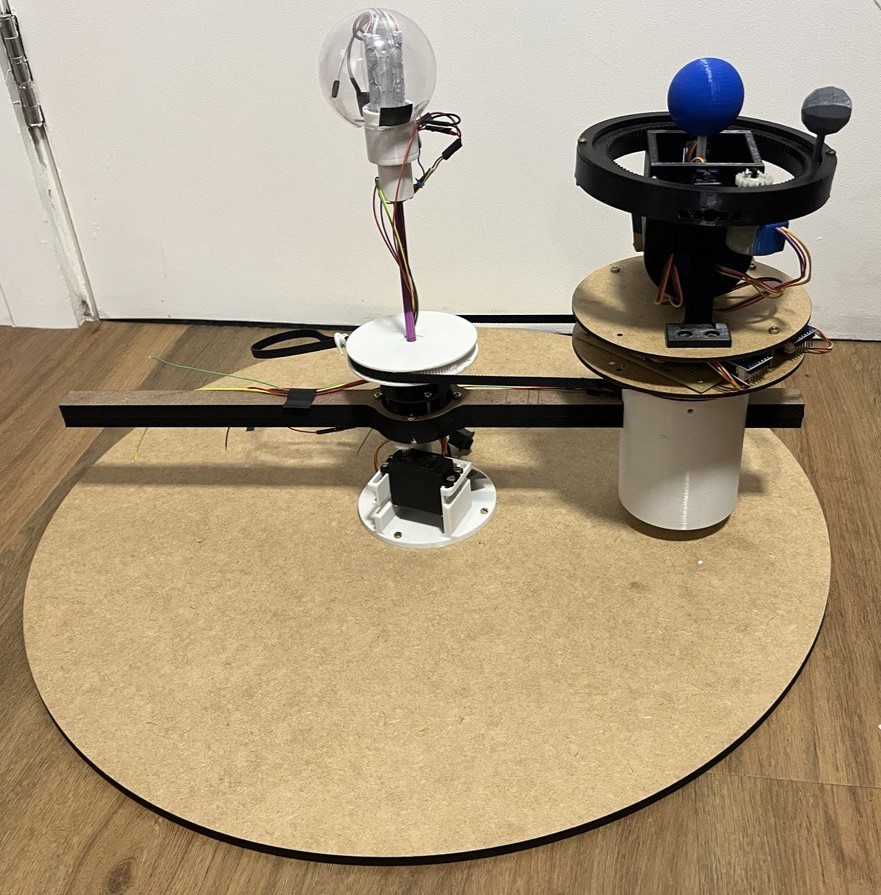
The first version was tested with Mercury, Venus, and Earth + Moon. All seven motion requirements were met — translation, rotation, axial tilt, satellite revolution, synchronous satellite rotation, direction-locked translation plane, and easy planet swap — except continuous translation (limited by the servo range, handled in firmware).
My contributions
Full mechanical design in Autodesk Inventor — planetary housing, ring gear, shaft, translation arm, modular brackets
Mathematical scaling of planet sizes, orbital distances, and rotation/translation speeds from real astronomical data
3D printing all structural and gear components in PLA; laser cutting base and mounting plates in acrylic/MDF
Arduino firmware — 4-motor synchronization with astronomically derived speed ratios and automatic translation return
Dynamic simulation in Inventor to validate movement before fabrication
Written thesis (125 pp.) documenting design decisions, scale derivations, and educational applications
Supervisors: Prof. Dr. Carla Maria Chagas E. Cavalcante Koike & Prof. Dr. Jones Yudi Mori Alves da Silva — UnB
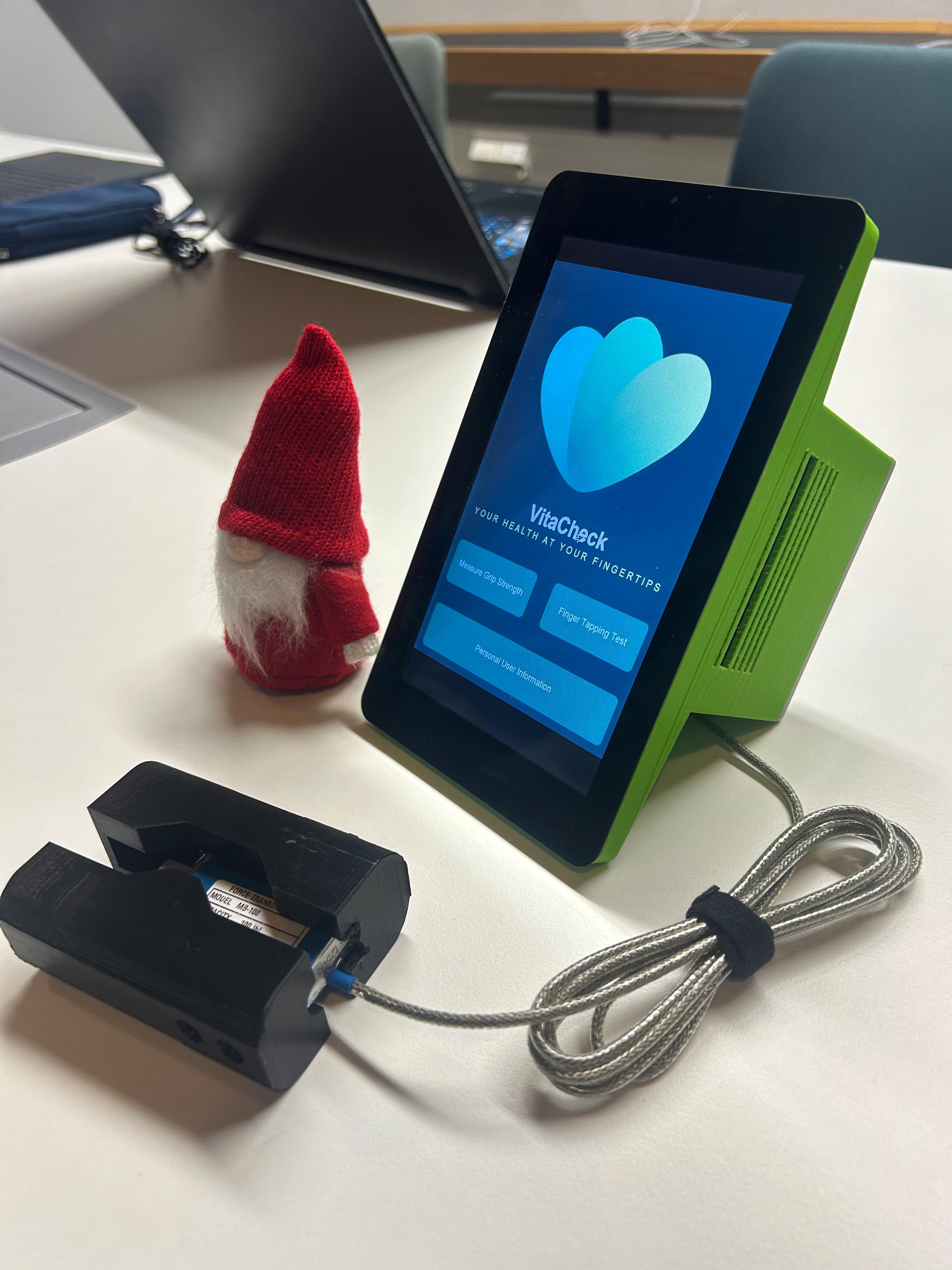
A sensor-based health monitoring prototype using grip strength and finger-tapping tests — two validated clinical assessments — to detect early signs of Parkinson's disease.
Parkinson's disease is typically diagnosed years after neurodegeneration has begun. Two of the earliest detectable symptoms — changes in grip strength and finger-tapping speed — are measurable non-invasively with the right hardware. Vitacheck aims to make these clinical tests accessible outside a hospital setting.
How it works
The system has two main components: a 3D-printed grip force sensor housing (MA-100 force cell) that the patient squeezes, and a tablet running the Vitacheck app. A second test asks the patient to tap a screen as fast as possible — a digitized version of the standard clinical finger-tapping test. Both signals are processed in real time with metrics displayed live in the GUI.
Design principle: The experience had to be intuitive for both patients and clinicians — the GUI was designed around the clinical workflow, not the engineering stack.
My contributions
Integration of MEMS-based force and motion sensors with embedded hardware
Full Python GUI development for real-time patient interaction and test administration
Signal acquisition pipeline — from sensor output to processed metrics
Cross-layer integration: hardware, firmware, and application software
2022–2024 · Data Engineer · AKAD Seguros
Transactional Data Lake on AWS
Three-layer data lake integrating 6 heterogeneous data sources, processing 100+ GB of insurance data — featured in an official AWS Brazil publication.
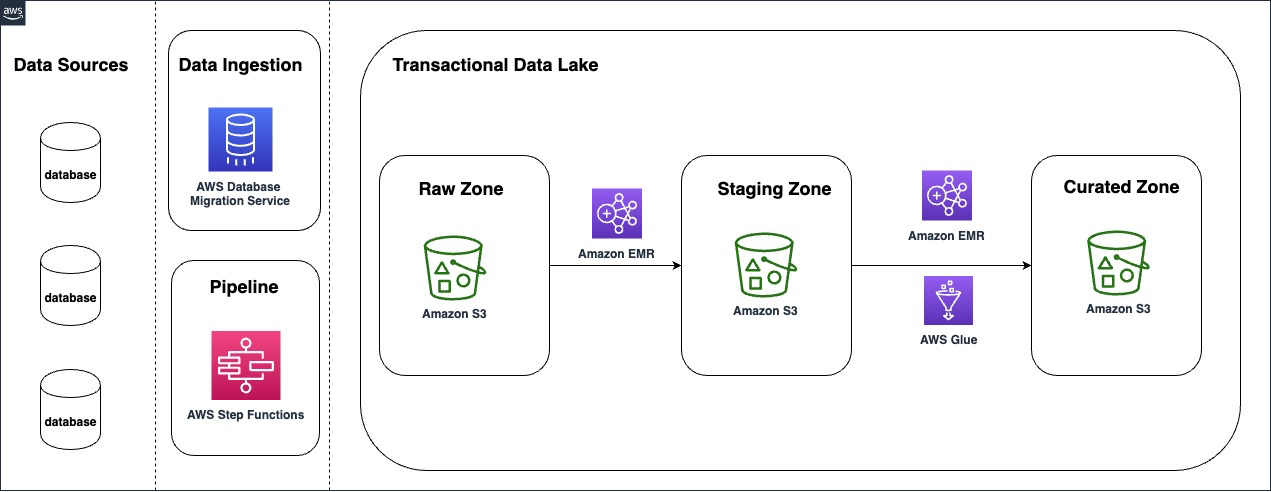
The platform follows a three-zone pattern: Raw Zone (exact source replicas), Staging Zone (cleaned, deduplicated), and Curated Zone (business-ready tables). CDC ingestion via AWS DMS; all processing on Amazon EMR with Delta Lake — enabling ACID transactions, upserts, schema evolution, and time-travel queries.
Scale: 100+ GB processed across Raw → Staging → Curated, fully orchestrated by AWS Step Functions.
Outcomes
Gave every business unit at AKAD access to clean, versioned, queryable data for the first time. One measurable outcome: reduced cargo insurance loss ratios. Featured in an official AWS Brazil blog post, credited as co-author alongside the AI Engineering Manager and AWS Solutions Architects.
My contributions
Full architecture design — three-layer schema, zone boundaries, data contracts
AWS DMS setup for CDC ingestion from 6 relational database sources
Delta Lake on Amazon EMR with ACID, upserts, and time-travel
Pipeline orchestration with AWS Step Functions
Data Warehouse build for Power BI and actuarial teams
Monitoring and observability with AWS CloudWatch across all stages
2019 · Trinity College Int'l Firefighting Home Robot Contest
Firefighting Autonomous Robot
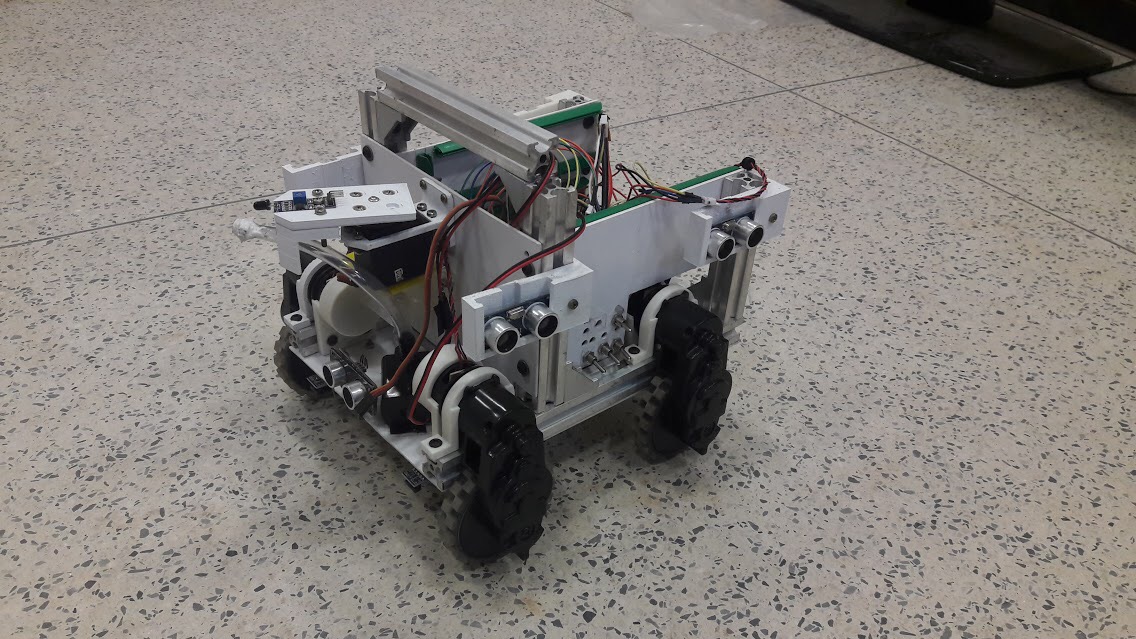
An autonomous robot that navigates a maze-like arena, detects a live candle flame, and extinguishes it — built for the Trinity College International Firefighting Home Robot Contest.
The Trinity College Firefighting Robot Contest places autonomous robots in a house-like maze. When an alarm triggers, the robot must navigate from its starting position, locate a lit candle, and extinguish it — all without human intervention. The arena layout is unknown in advance.
Design & engineering
Led structural CAD modeling in Autodesk Inventor, then fabricated components via 3D printing and aluminium profile framing. Arduino-based embedded logic handled ultrasonic wall-following navigation, flame sensor array direction finding, and motor control for drive and the extinguisher mechanism.
Creative solution: A sealed bird water feeder was repurposed as the on-board water container — leak-proof, lightweight, and electronics-safe.
My contributions
Full robot structure modeled in Autodesk Inventor
3D printing of custom structural and mounting components
Arduino embedded logic: sensor input, navigation, flame detection, motor control
Water containment solution: sealed bird feeder as reservoir
Integration and system-level debugging ahead of competition